


Inside the Memory Supercycle's Second Act


Memory contract prices are rising at roughly a fifth of the rate they were two quarters ago. That is the most misleading number in the market right now.
Conventional DRAM contract prices rose 90–95% quarter over quarter in Q1 2026, a record. Q2 came in at 58–63%. Server DRAM is forecast at 13–18% for Q3. Spot prices have not slowed at all: the mainstream DDR4 8Gb chip reached $42.08 on July 28, up from $33.02 in early March, with no sustained multi-week decline since April.
The shortage has not eased. It has split, and which side of it you are on is now decided by paperwork rather than by what you buy.
Three things changed since April
Long-term agreements are rerouting the increases. The major cloud providers have locked in contracts, so their pricing is contractually capped. TrendForce expects the remaining pressure to shift toward buyers without those agreements, and contract prices are still forecast to rise every quarter through the second half of 2027.
DDR4 and DDR5 are converging. DDR4 still trades at a 65–67% premium per gigabyte over DDR5, but that premium was about 82% in April. DDR5 16Gb rose 36.1% since our last edition against 23.8% for DDR4, so the sharper tightening this quarter happened one generation up.
2027 is a supply problem. SK hynix expects it to be the worst supply year in the industry's history, and the KRW 54.3 trillion it approved on August 7 delivers its first cleanroom in June 2029. None of the capacity being funded now adds a bit to 2026.
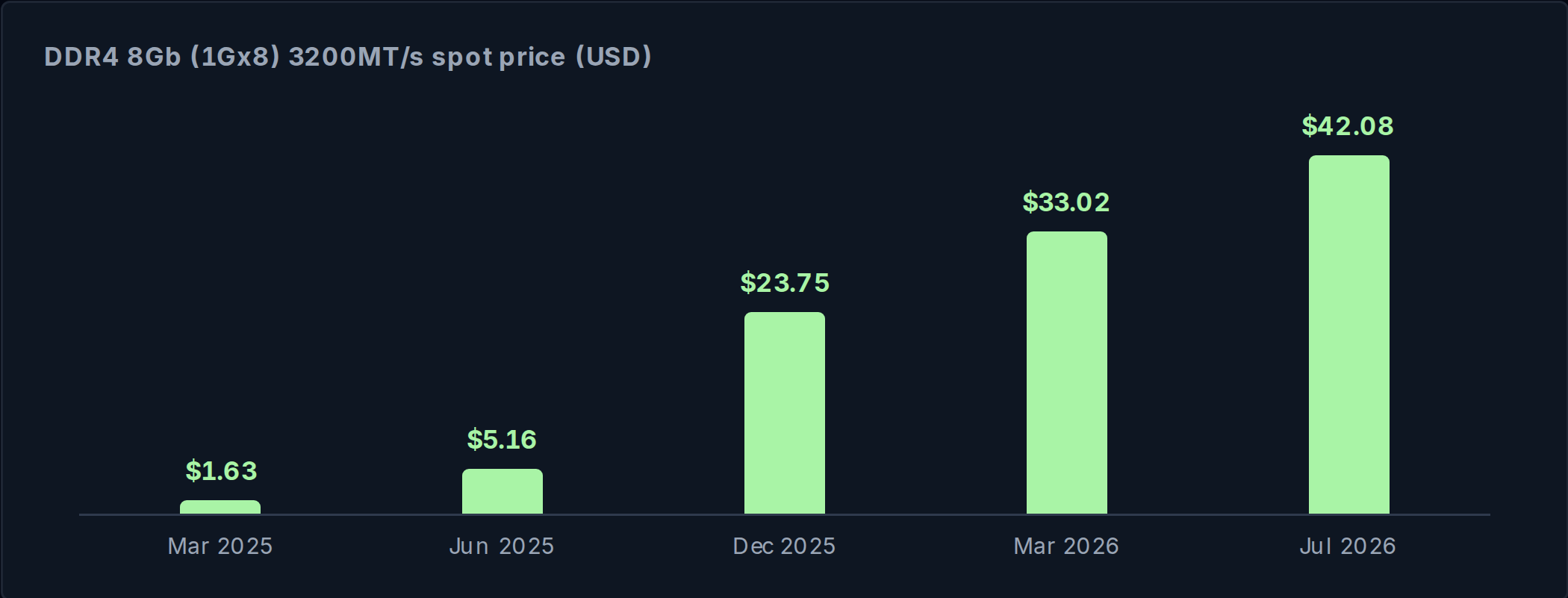
DDR4 8Gb (1Gx8) 3200MT/s spot price, via TrendForce weekly spot bulletins.
Who is most exposed
Automotive, industrial, and medical platforms share one problem: they were designed years ago on DDR3 and DDR4, with no quick path off them. S&P Global Mobility estimates new-contract automotive DRAM prices rising 70% to 100% in 2026, and a mid-program memory change forces revalidation, or in medical, full regulatory requalification. These buyers can neither wait out a shortage nor redesign around it, which is why the secondary market has become a primary sourcing channel for them.
What this means right now
Memory has moved from the edge of the Mobius marketplace to the center of it. Across January to July 2024, memory categories were 4.0% of all RFQs submitted on the platform. Across the same seven months of 2026 they were 12.6%.
If you're buying: Do not read the Q3 deceleration as relief. Without a long-term agreement, you are the segment the remaining increases are expected to come from. Quote widely, because the same DDR4 8Gb part is quoted between $20.20 and $74.00 today, and at 40 to 52 week lead times, orders placed this quarter are 2027 deliveries.
If you're selling: Between January and July 2026, close to 80% of all buyer bid value on RAM parts expired without a seller accepting it. Active rejections accounted for well under 1%. The dominant outcome was no response at all.
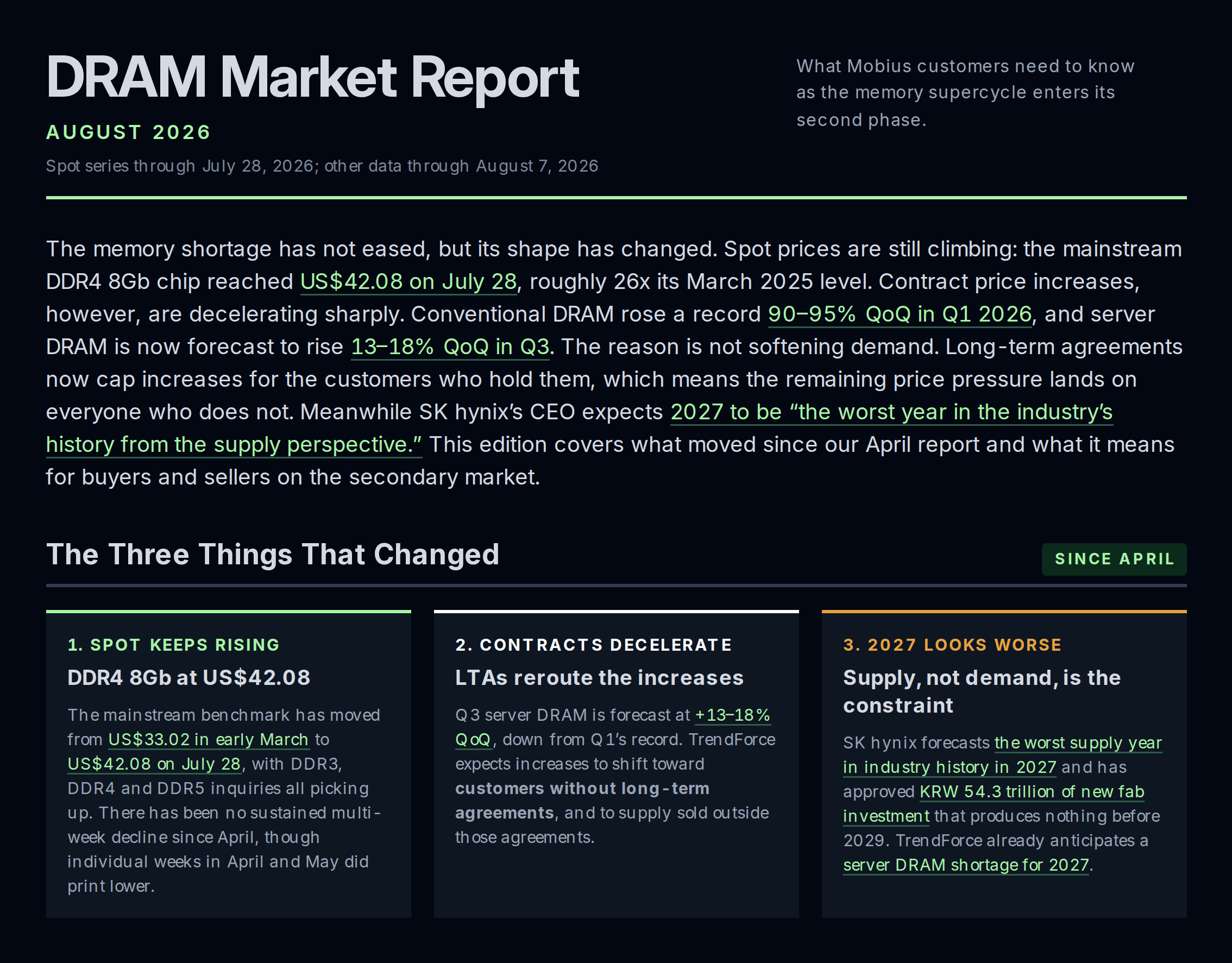
The August edition covers pricing through July 28, allocation and fill rates, DDR4 end-of-life status, downstream sector exposure, supplier economics, and counterfeit risk.
Read the August 2026 DRAM Market Report
If the current market affects your specific parts or inventory, we are happy to talk.
Schedule time with the Mobius team
Sources: TrendForce, DRAMeXchange, S&P Global Mobility, SK hynix, Counterpoint Research, Mobius Materials platform data (January to July 2026).


