


Inside the First Semiconductor Memory Supercycle in Seven Years


If you source, sell, or build anything that uses memory chips, the market just shifted under you — and faster than most procurement teams were ready for.
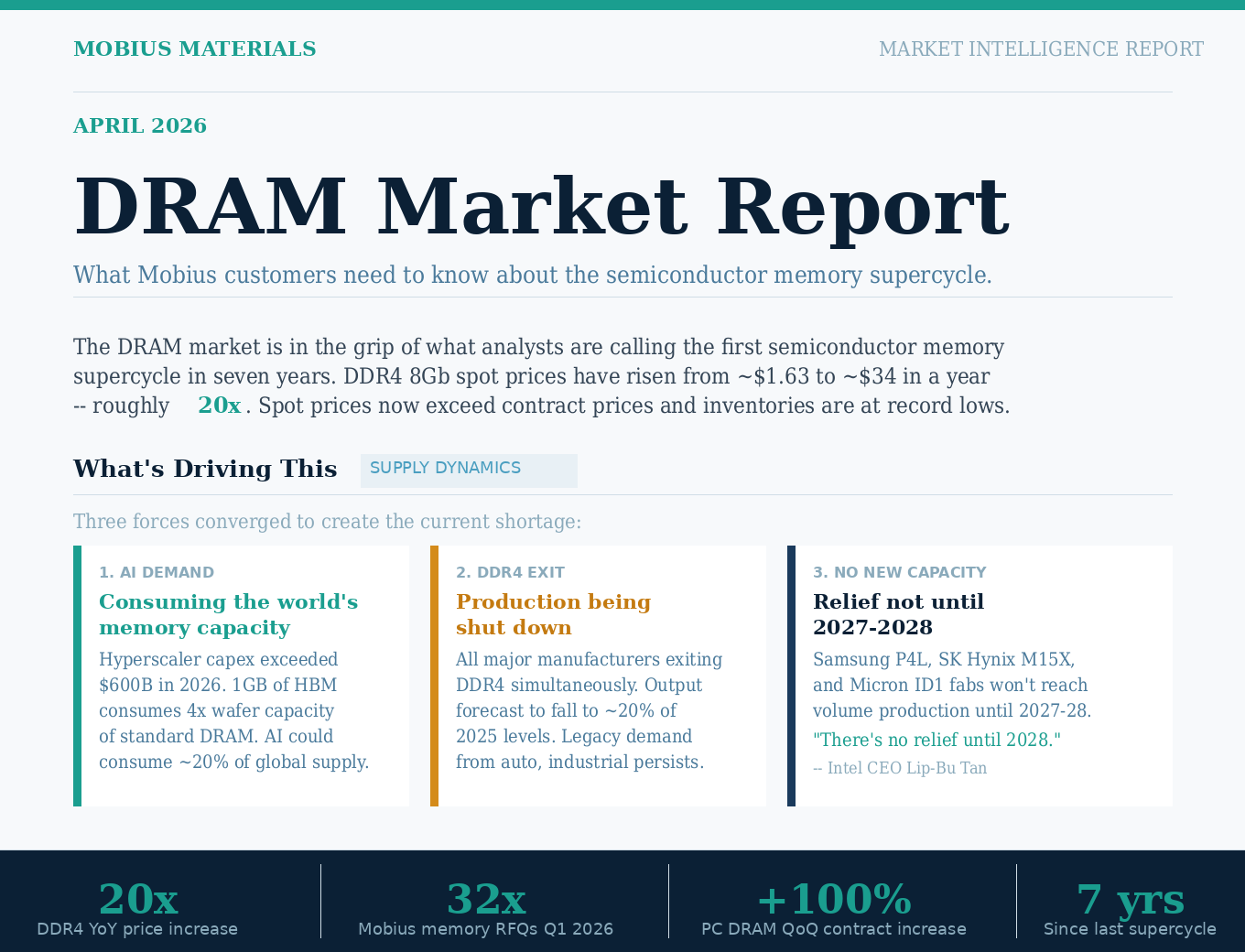
DDR4 8Gb spot prices have risen roughly 20x in the past year. PC DRAM contract prices jumped over 100% in a single quarter — the largest increase on record. Distributor inventories have fallen to 2–4 weeks of supply, down from 8–12 weeks a year ago. Analysts are calling it the first semiconductor memory supercycle in seven years.
The market has started pulling back from those peaks — spot prices are down, chip stocks sold off after Google's TurboQuant announcement, and some buyers are waiting it out. But the pullback reflects buyers resisting record-high prices, not supply catching up. For manufacturers sourcing commodity DDR4, the picture hasn't meaningfully changed.
Here's what's driving it.
Three forces hit at once
AI is consuming the world's memory capacity. Producing 1GB of HBM — the memory used in AI accelerators — consumes 4x the wafer capacity of standard DRAM. As Samsung, SK Hynix, and Micron reallocate capacity to fill open-ended orders from Google, Microsoft, and Amazon, every wafer that moves is a wafer denied to commodity DRAM.
DDR4 production is being shut down while demand persists. All major manufacturers are exiting DDR4 simultaneously. Production is forecast to fall to roughly 20% of 2025 levels this year. The problem: industrial controllers, automotive ECUs, medical equipment, and hardware designed before the DDR5 transition still requires DDR4. That demand doesn't disappear because manufacturers stop making the part.
New capacity won't arrive until 2027–2028. Samsung's P4L fab, SK Hynix's M15X, and Micron's ID1 are not coming online until 2027 at the earliest. As Intel CEO Lip-Bu Tan put it: "There's no relief until 2028."

Who's feeling it most
PCs and smartphones are taking the headline hits — IDC forecasts 11.3% and 12.9% unit declines respectively as OEMs pass through costs or cut memory configurations to hold price points.
Automotive is quietly one of the most exposed sectors. Lead times have stretched to 30–42 weeks and DRAM prices for automotive applications are expected to rise 70–100% in 2026 as chip makers explicitly deprioritize automotive in favor of data center customers.
Industrial and medical are in a particularly difficult spot. These sectors depend on DDR4 for long-lifecycle platforms that can't easily redesign for DDR5. Authorized channels aren't meeting demand — which is exactly where the secondary market comes in.
What this means right now
The authorized channel is under real strain. Suppliers are filling only 35–40% of orders for smaller OEMs. When the primary channel can't meet demand, the secondary market stops being a discount alternative and becomes a critical supply source.
On the Mobius platform, memory RFQ quantity in Q1 2026 alone was 32x the total for all of 2024. Average bid prices on memory parts increased 19x in six months.
If you're buying: Lead times of 26–42 weeks mean orders placed today may not arrive until Q4 2026. Availability matters more than price right now — and the window to secure supply is narrowing.
If you're selling: Components written off as excess in 2023–2024 may now be worth multiples of their original cost. DDR4 inventory that looked like a liability 18 months ago is now in high demand.
Get the full analysis
We put together a complete market report — price trends across DDR4 and DDR5, supply allocation and fill rates by customer tier, sector-by-sector impact, and specific guidance for buyers and sellers navigating this market.
Read the Full DRAM Market Report
Questions about how this affects your specific parts or inventory? We're happy to talk.
Schedule time with the Mobius team
Sources: TrendForce, IDC, DRAMeXchange, S&P Global, Rand Technology, Mobius Materials platform data (Q1 2026).


